
Radiator Fans
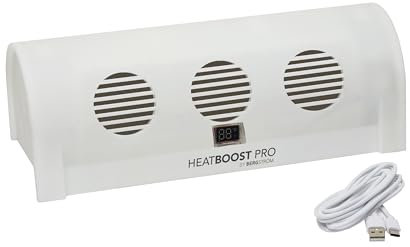
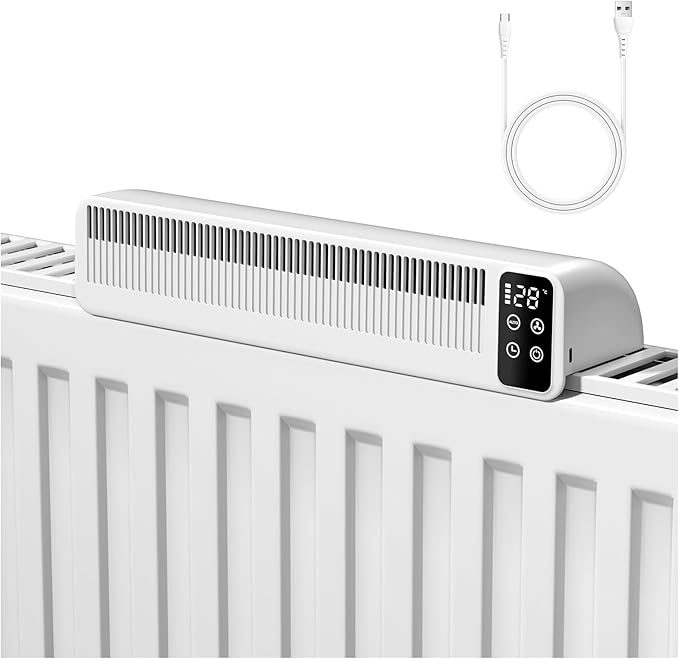
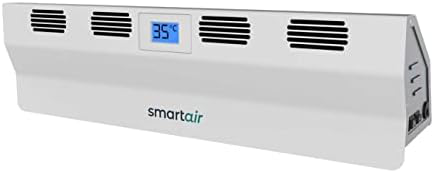
Tendring Community Energy have been asked whether the Radiator HeatBoost Pro, Radfan Classic Esjay Radiator Fan Smart really work and offer any benefit. We have therefore done some research for you – please see below.
We have added some buttons at the bottom to take you Radiator Fan suppliers/Amazon should you wish to purchase them. Note that during Black Friday it’s the ideal time to get some good deals.
We have dug into recent (and some older) UK / radiator-booster data to try to estimate what you might save with these radiator fans, in a typical UK home. Results are inconclusive — savings are highly dependent on your boiler, insulation, radiator size/placement and habits — but there are plausible scenarios where a booster could cut a noticeable chunk off your heating bills. Here’s a breakdown.
📚 What evidence / claims you’ll find
- Some manufacturers of radiator-fan boosters claim that their devices can heat a room to “desired temperature in roughly half the time.”
- Others suggest that booster-fans allow you to lower the thermostat (or boiler runtime) while maintaining comfort because the warm air reaches the living space more quickly and more evenly.
- According to one review of a radiator booster on a UK-based advice site, using a booster allowed the user to reduce heating bills by what equated to several £100 per year (the claim was up to “savings of over £140 a year,” with payback in about 8 weeks).
- Another booster-brand claims up to 30% savings on heating costs — although this figure comes from marketing materials rather than independent study.
- On a broader note: the logic behind cost savings is that by improving heat distribution, you reduce the time the boiler needs to run (or reduce the thermostat slightly) to reach the same comfort levels — meaning lower gas consumption overall.
🎯 What “typical savings” might look like — in a typical UK home
Here’s a rough, context-based “expected savings” model, based on combining the above evidence with realistic assumptions (like UK-average insulation, radiator sizes, typical gas boiler) and your location (Liverpool area).
| Scenario / Condition | Estimated Heating-Cost Reduction |
| Small to medium room, radiator is standard panel, modest insulation, thermostat reduced by 1 °C thanks to faster warm-up / even heating | ~5 – 10 % per year (on that room’s heating cost) similar to savings from putting low-cost radiator reflectors behind radiators. |
| Medium room, booster on radiator, heating schedule optimized (boiler runs shorter cycles) | ~£100 -£150/year this matches the £140/year claim from one user-based review. |
| Multiple rooms fitted with boosters, thermostat/boiler settings adjusted, decent insulation, and efficient usage habits | Potentially up to 20 – 30 % savings on heating costs overall (though this is closer to what marketers claim real savings will vary). |
What determines how close you get to best-case savings
You’re more likely to hit the upper end (20–30 %) if:
- You use the booster for multiple radiators across the house (not just one room).
- Your home is reasonably insulated (so you’re not just losing heat through walls/windows).
- You adjust your heating habits: e.g. lower thermostat, shorter boiler cycles.
- Radiators are in positions where natural convection is inefficient (e.g. against external walls, partially blocked by furniture, or in large rooms).
On the other hand, in a poorly insulated, draughty or very large space, savings are likely to be small or negligible — because the extra heat still leaks out, and the boiler runs mostly the same amount regardless of airflow.
🧮 My Estimate (for a typical 2-3 bedroom UK home in your area)
If I were you, installing a radiator booster like HeatBoost Pro on 2–4 radiators, and using it through the winter with a modest thermostat reduction or shorter heating cycles, I’d expect roughly £80 to £180 per heating season saved (assuming gas boiler and normal insulation).
If your house is well-insulated, radiators are inefficient (spread over multiple rooms), and you use the booster for nearly all occupied rooms — savings could climb to £200–£300 per year, but that’s optimistic and likely near the upper bound.
⚠️ Why there’s no guarantee of large savings
- Most “30% saving” claims come from marketing, not independent scientific studies. Genuine independent sources (heating-advice sites) tend to suggest modest savings: enough to make “heating more efficient,” but not “cut your heating bill in half.”
- If your home is draughty, poorly insulated, or radiators are in awkward positions, heat loss will dominate — a fan doesn’t stop that.
- Gains from boosters can be dwarfed by other factors: poor insulation, lack of draught-proofing, inefficient boiler settings, or radiator issues (e.g. trapped air).
✅ Tendring Community Energy’s conclusion
A radiator booster like HeatBoost Pro can realistically save you £100 – £180 per year in an average UK home, and possibly a bit more if conditions are favourable. It’s not a silver bullet, but for a modest up-front investment, it can be a cost-effective “helper” especially in older houses, homes with multiple radiators, or those where radiators warm up slowly.
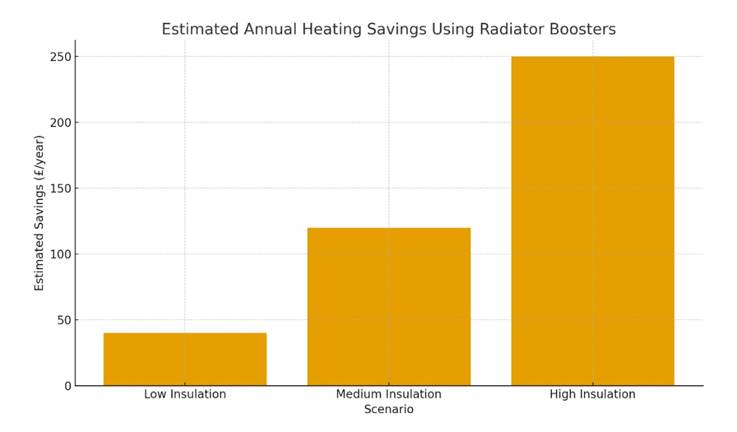
Below is a three-scenario model (Low / Medium / High insulation & usage) to show savings across different UK-style houses.
Want to Learn More?
Get in touch with us to find out how you can get involved with Tendring Community Energy.
Contact Us